When Someone Does Ask
When someone does ask how you are, it can stop a caregiver in their tracks. The group talked about when to answer honestly, a few answers that have worked, a caregiver's version of the pain scale, and why asking back matters.
The room gave real space to something that is easy to miss. When someone does ask a caregiver how they are doing, and seems to mean it, it makes us pause.
That pause is rare. Most days do not have room for it. And sometimes it is hard, because the honest answer is one we have not had a minute to look at ourselves. A caregiver can go weeks knowing exactly how the care recipient slept, ate, and felt, and have no idea how they are doing themselves.
The group came to see that pause as an opportunity. It is the perfect moment to check: am I floating, or am I flailing?
Why We Say “Okay”
Often a caregiver says they are doing okay. The group named two reasons, and both are reasonable.
Sometimes we simply don’t want to get into it. The full answer is long, it is heavy, and there is a grocery line or a hallway or a bus stop involved.
And sometimes we say okay because we can tell the person doesn’t really want to know. That instinct is often right. In the survey described in How Is the Caregiver?, nearly a quarter of people said they answer “fine” because they don’t think the person asking is really interested.
There is no right way to decide when to answer honestly. A few questions some of us find ourselves weighing in that split second: Who is asking? Do they have the time to hear it? Do I have the energy to say it, and to handle their reaction? Would it help me to say it out loud right now? The answer can be different on different days, with the same person.
A Few Answers That Have Worked
The group shared some of the ways they have answered. Each one leaves room to say more, or not.
“One day at a time.” True, short, and gently closes the subject without pretending everything is fine.
“On a scale of 1 to 10, I’d say…” Like describing pain at the doctor’s office. A number is honest without requiring the whole story, and it lets the other person decide whether to ask a follow-up. It also gives you a quick reading, which is useful in its own right.
“I appreciate you asking. I am…” This one acknowledges that the question itself mattered, and then lets you choose how far to go. Many of us find that thanking someone for asking makes it easier to tell them the truth.
A Caregiver’s Scale
The pain scale idea stayed with the room, so we drew a version of it, in the language of floating and flailing. At the bottom is sinking with no lifeline in sight. One step up is still desperate, but there is a lifeline somewhere on the horizon, even if it is far away. In the middle is the long stretch of flailing and treading water that many of us know best. And at the top is floating: breathing, not fighting, letting the water hold you for a while.
This is not a clinical tool, just a starting point. Your own words for each number may be different.
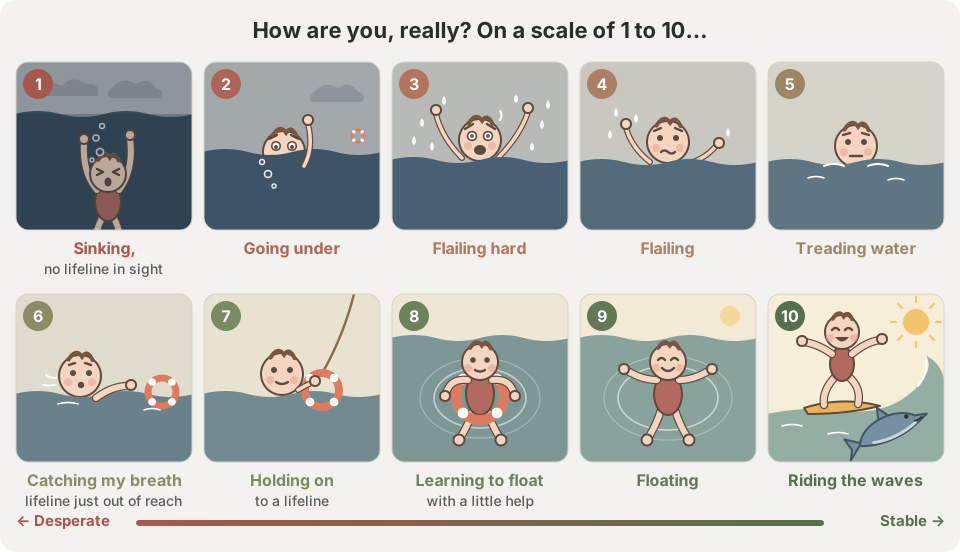
Some caregivers find it helps to check the number privately, even when the answer they give out loud is still “okay.” Others have started giving the number outright to a friend or two who have earned it.
Asking Back
The group landed on something that felt important: modeling the behavior we wish we saw. When someone asks how we are, we can ask them back, and mean it.
“I appreciate you asking. I’m about a five today. How are you doing?”
Asking back does a few quiet things. It shows what it looks like when the question is asked as a real question. It keeps the exchange going both ways, which is part of any friendship that lasts. And it reminds both people that the caregiver is still a person with friends, and not only a source of updates about someone else.
Where We Have Been Before
- The Symptoms No One Sees, which includes the idea of having one plain sentence ready.
- Things Not to Say to a Caregiver.
- The Face We Show, on the effort of holding it together in front of people.
- What Counts as Good Today.